I. Industry Context: From “Just Displaying” to “Integrated into Space”
Over the past decade, indoor fine‑pitch LED displays have evolved from P3 and P2 down toP1.5, P1.2, and even smaller pitches. Advances in packaging technology, control systems, and image processing have enabled LED screens to move beyond outdoor billboards and large‑stage setups into conference rooms, showrooms, shopping mall atriums, control centres, and other indoor environments.
Yet this progress brings new trade‑offs. Higher pixel density and resolution demand greater installation precision and complicate maintenance. Better visual performance imposes stricter requirements on space, heat dissipation, and power consumption. When deploying fine‑pitch LED indoors, three core tensions consistently arise: image quality vs. cost, space vs. installation, and performance vs. energy efficiency.
The seven models in the MTV series are engineered to address these tensions head‑on. All featured capabilities described below are drawn directly from the official product specifications.
II. Core Features and Application Value
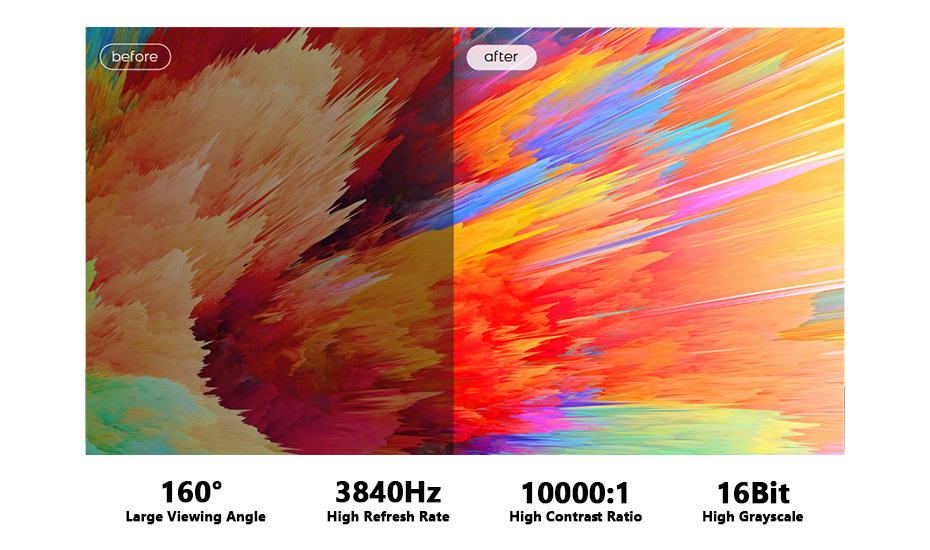
3840Hz Refresh Rate + 16‑bit Gray scale – Ensuring a Comfortable Close‑View Experience
The entire MTV line delivers a 3840Hz refresh rate and 16‑bit gray scale processing. Refresh rate governs motion smoothness – at 3840Hz, it far exceeds the human eye’s perception limit, eliminating motion blur and scanning lines even during fast‑scrolling data streams or video playback. Gray scale depth determines colour transition fidelity – 16‑bit gray scale provides 65,536 steps from darkest to brightest,enabling precise colour reproduction for high‑resolution charts, design work,and critical visual content. For 24/7 monitoring centres or broadcast studios that require camera‑friendly displays, these two metrics directly impact viewing comfort and the accuracy of information delivery.
Front‑Access Maintenance – Maximising Valuable Indoor Space
The MTV series adopts a pure front‑access design, allowing all installation and maintenance to be performed from the front of the screen. Traditional rear‑access displays require 60–100 cm of clearance behind the screen for servicing. With front‑access,the screen can be mounted flush against the wall. For high‑rent indoor environments such as office buildings and shopping malls, every square metre saved translates into tangible cost savings over the long term. The modular,plug‑and‑play design enables individual modules to be replaced quickly from the front, reducing fault repair time from hours to minutes – a critical advantage for mission‑critical applications like control rooms and airport flight information displays that operate around the clock.
Die‑Cast Aluminium Cabinets + Curved Splicing – Balancing Precision and Design Freedom
High‑precision die‑cast aluminium integrated cabinets ensure flatness and structural stability across large‑scale tiled installations, minimising visible seams that can degrade the viewing experience. With ±15° curved splicing capability and six cabinet size options (500×250, 750×250, 1000×250, 500×500, 750×500, and 1000×500 mm), the MTV series supports curved, wave‑shaped, and other creative configurations. This allows the screen to become an integral part of the architectural design rather than a mere “attached device.”
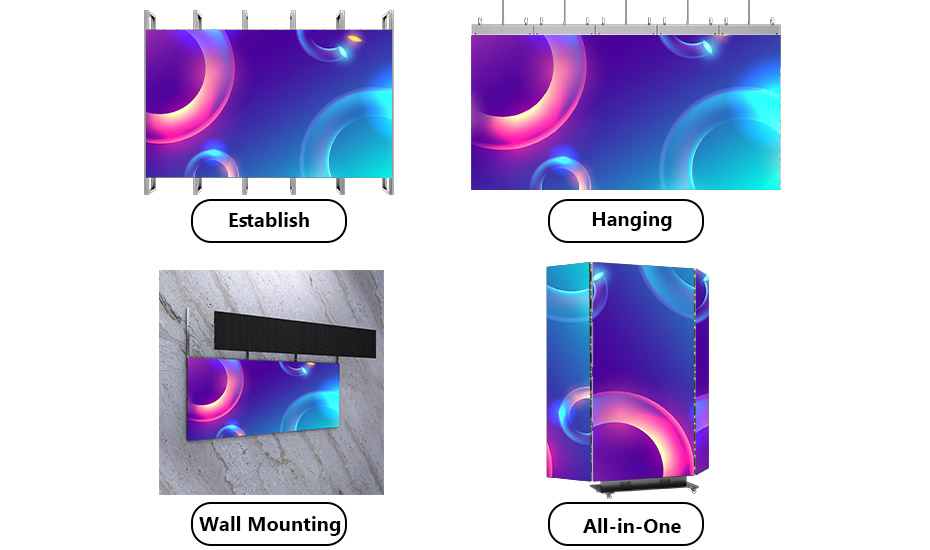
Multiple Mounting Options – Flexible Adaptation to Diverse Scenarios
The series supports ceiling‑hung, floor‑standing, wall‑mounted, and integrated installation methods. A single product line can be deployed in shopping mall atriums, corporate meeting rooms, or temporary exhibition halls, reducing selection complexity and inventory overhead for system integrators.
Low Power Consumption – Reducing Long‑Term Operating Costs
Typical power consumption ranges from 100 to 200 W/m², with a maximum of 350 W/m². Indoor LED screens often run 8–16 hours daily, accumulating 3,000–6,000 operating hours per year. Power consumption differences may seem negligible day‑to‑day, but over a 3‑ to 5‑year life cycle, they represent a quantifiable cost variance. Lower power draw also means less heat generation and quieter operation – a significant benefit for boardrooms, control centres, and digital signage that run continuously.
III. Product Selection Guide
Pixel pitch determines the optimal viewing distance:
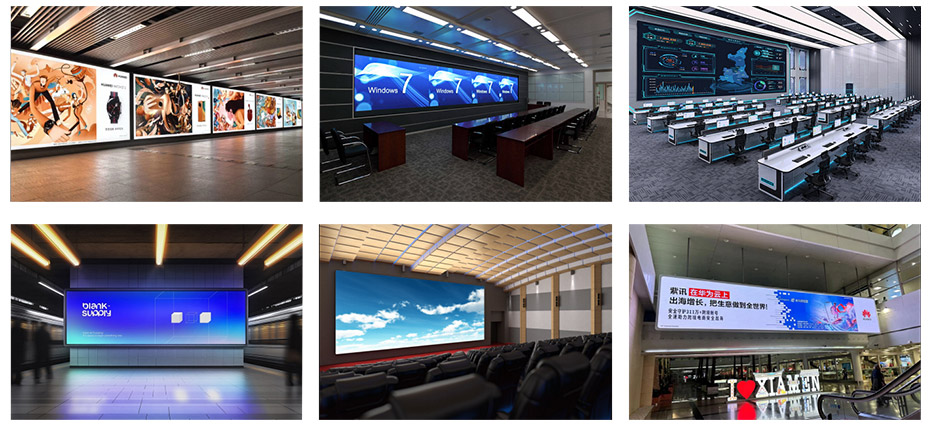
MTV12 / MTV15 (1.25 / 1.56 mm) – ideal for close‑up scenarios such as premium conference rooms, control centres, and broadcast studios.
MTV19 / MTV25 (1.95 / 2.5 mm) – suited for mid‑distance applications like corporate showrooms, retail stores, and hotel lobbies.
MTV29 / MTV39 (2.976 / 3.912 mm) – best for long‑distance viewing in shopping mall atriums, sports venues, and large‑scale exhibitions.
All seven models share the same cabinet dimensions and module specifications, enabling flexible switching across different resolution requirements and simplified spare parts management.
The MTV series responds to the real‑world demands of indoor environments across three dimensions – image quality, installation, and energy efficiency. It enables customers to install an indoor LED screen without having to compromise between display performance, space utilisation, and operating costs. For detailed technical specifications and dimensions, please learn more the FOCONO MTV series.






 Tel : 86-755 81789418
  Fax : 86-755 89345780
 WhatsApp : 86-13828829420
 E-mail : focono@focono.com